 Webhook
Let other systems start automations by calling a URL, and send events, automation results and approved agent messages to a URL of yours.
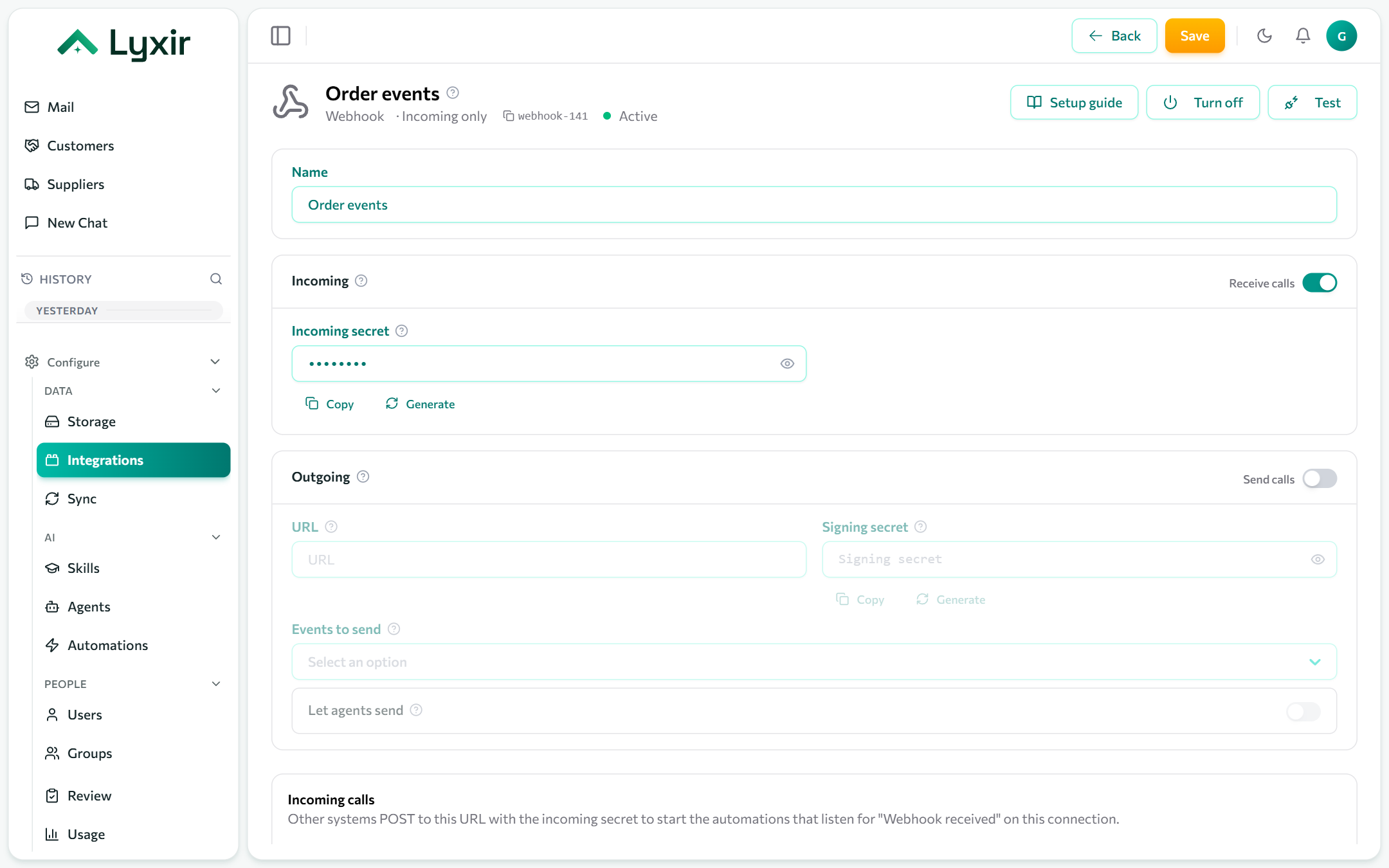
Incoming: start automations
- Integrations → Add → Webhook.
- Under Incoming, turn on Receive calls and set an Incoming secret: any long random text.
- Save. The connection's URL appears.
- Make an automation that runs on Webhook received from this connection.
Callers POST to the URL, sending the secret in one of:
- an
Authorization: Bearer <secret>header, - an
X-Webhook-Secretheader, - a
?secret=query parameter.
curl -X POST "https://acme.example.com/api/webhooks/in/42/" \
  -H "Authorization: Bearer $SECRET" \
  -H "Content-Type: application/json" \
  -d '{"order": 1042, "status": "delayed"}'
Use the URL shown on the connection. The body (up to 256 KB) is handed to the
automation, and the call is answered 202 at once.
Outgoing: send calls to your URL
Under Outgoing, turn on Send calls and set:
| Field | What goes there |
|---|---|
| URL | A public https address. Private and internal addresses are refused. |
| Signing secret | Signs every call. Empty: calls are unsigned. |
| Events to send | Events forwarded as they happen, from every connection. |
| Let agents send | Agents given this connection may propose a call; each waits for a person to approve it. |
Automations can also send their results here.
Checking a call is ours
Each call carries X-Webhook-Timestamp and
X-Webhook-Signature: sha256=<hex>, the HMAC-SHA256 of
<timestamp>.<body> with the signing secret. Recompute it, compare in constant
time, and reject old timestamps:
import { createHmac, timingSafeEqual } from 'node:crypto';

function isOurs(secret, timestamp, body, signature) {
  if (Math.abs(Date.now() / 1000 - Number(timestamp)) > 300) return false;
  const expected = `sha256=${createHmac('sha256', secret).update(`${timestamp}.${body}`).digest('hex')}`;
  return expected.length === signature.length && timingSafeEqual(Buffer.from(expected), Buffer.from(signature));
}